The practical takeaways for low-slope roofs
- Modified bitumen is a layered asphalt membrane built for low-slope roofs, not steep shingles.
- SBS is usually the more flexible choice; APP is usually the hotter-climate choice.
- Self-adhered systems reduce fire and odor concerns, while torch-applied and hot-asphalt systems demand stricter safety control.
- Drainage, seam quality, and flashing details matter more than the brand on the roll.
- In the U.S., installed pricing commonly lands in the mid-single digits to low double digits per square foot, depending on tear-off and detailing.
- With good maintenance, a well-installed roof can often deliver about 20 to 30 years of service.
What this roofing system is doing on a flat roof
I think of this roof type as an asphalt membrane that was engineered to behave better than plain asphalt. The sheets are reinforced, then modified with polymers so they can flex, resist movement, and stay watertight in low-slope conditions where shingles would be the wrong tool. The system is built in layers, and those layers are the reason it performs better than a single thin membrane when the building moves, heats up, or sees a lot of wind.
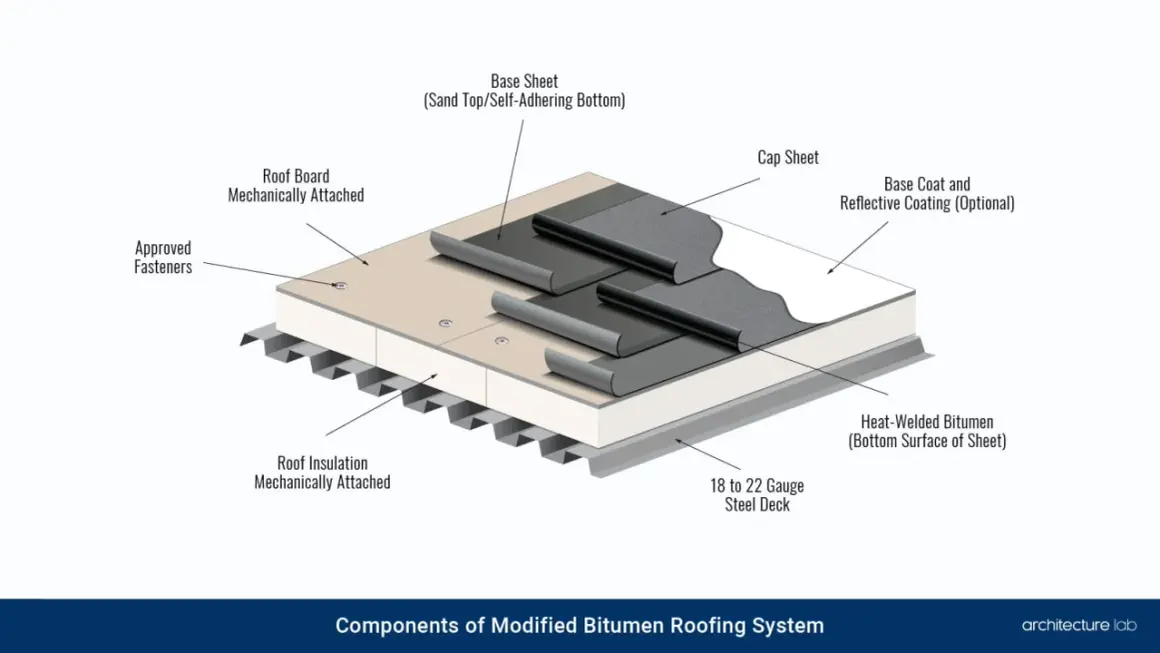
“Plies” simply means layers. In a typical low-slope assembly, the base sheet helps build the body of the roof, and the cap sheet takes most of the weather exposure. On a real flat roof, that layered redundancy is not a luxury; it is the feature that gives you repairability and a bit more tolerance for small imperfections. The catch is that the roof only performs as well as its seams, edges, and transitions.
This is why I usually separate the material from the system. A good membrane can still fail if the deck is wet, the slope is wrong, or the flashing at a wall or pipe is careless. The roof is a system, not just a roll of asphalt. Next, I want to show the pieces that make that system work.
How the layers and surfacing protect the roof
The surface finish is not cosmetic. On granulated sheets, the mineral surface shields the asphalt from ultraviolet light and helps the top layer hold up under weather and occasional traffic. Smooth sheets are useful in some assemblies, but they usually need to be part of a larger system with the right protection strategy above them. When the surfacing is wrong for the job, the roof ages faster than it should.
The main components are easy to understand once you separate them:
Base sheet
This is the first layer over the prepared deck or insulation. It gives the assembly stability and, in many systems, provides a good bond surface for the next layer.
Cap sheet
This is the weathering layer. It is the sheet you are relying on for UV resistance, water shedding, and long-term surface durability.
Granule surfacing
Those embedded mineral granules are there to protect the membrane from sun and physical wear. They also help the roof keep its surface integrity on exposed low-slope sections.
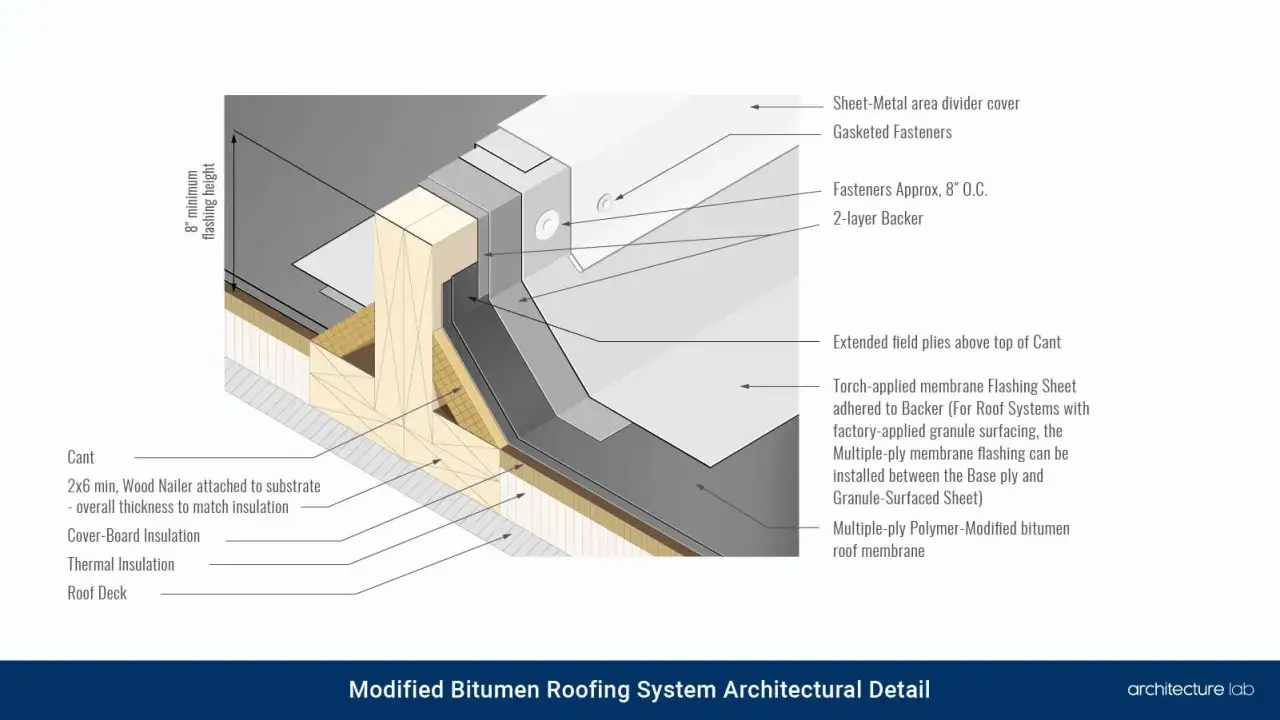
Flashing membranes
Flashing is the waterproofing used at edges, walls, curbs, pipes, and other penetrations. It is where many leaks begin, because those details are more complex than the open field of the roof.
If I could give one practical rule here, it would be this: the more complicated the roof geometry, the more important the detailing becomes. Simple rectangles are forgiving. Roofs with parapets, HVAC units, and multiple penetrations are not. That leads directly into the question of which version of the system actually fits the building.
Which version makes sense for your climate and access
There are two different choices hidden inside this topic: the membrane chemistry and the installation method. I would not choose either one by habit. I choose it based on climate, fire risk, access, and whether the building is occupied during the work.
| Option | Best fit | Main strength | Main tradeoff |
|---|---|---|---|
| SBS membrane | Cold or mixed climates, roofs with movement, most low-slope retrofit work | Flexible and forgiving; handles thermal movement well | Still depends on good detailing and drainage |
| APP membrane | Hotter, sunnier roofs where heat resistance matters | More heat-stable and rigid once installed | Usually less flexible than SBS |
| Self-adhered system | Occupied buildings, small roofs, projects with fire restrictions | No open flame or hot asphalt on the roof | Substrate prep matters more; the roof must be dry and clean |
| Torch-applied or hot-asphalt system | Experienced crews, traditional multi-ply work, controlled job sites | Strong bond and proven performance | Higher safety burden, more odor, more site controls |
In plain English, SBS is usually my first look for cold-weather flexibility, while APP makes more sense when heat is a bigger concern than movement. Self-adhered products are attractive when I want to avoid flames and bulky kettles, especially over garages, porches, or occupied spaces. Torch and hot-asphalt methods still have a place, but only when the crew is trained and the site allows that level of risk control. With the option sorted, the real question becomes whether the roof is prepared well enough to make any of them succeed.
What installation quality decides whether it lasts
I put most failures in this category. Not because the membrane is weak, but because the assembly underneath it is often compromised before the first roll is laid. A dry, sound deck and the right slope are not optional details. They are the foundation of the entire roof.
Start with drainage, not the membrane
ARMA points to a minimum slope of about 1/4 inch per foot in code-related guidance for low-slope asphalt roof systems, and that is the right mindset. Water needs a path off the roof. If the deck is too flat, a tapered insulation package or other drainage correction is usually the better fix than hoping the membrane will compensate. If water is still sitting after 48 hours, I treat that as a drainage problem that needs attention, not a minor cosmetic issue.Prepare the substrate carefully
The surface must be clean, dry, and stable. If there is trapped moisture, soft decking, or an uneven transition, the membrane will telegraph those problems later. That is where blistering, seam stress, and premature wear begin.
Get the flashing right
Flashings are the waterproof transitions at parapets, walls, curbs, and penetrations. They are often where the first leak shows up because they have more edges and more movement than the open roof field. I want reinforced details, clean terminations, and no shortcuts around pipes or corners.
Read Also: Roof Framing Guide - Rafters, Trusses, & Lasting Durability
Respect lap widths and product instructions
Many systems rely on specific side-lap and end-lap dimensions, and heat-welded assemblies often call for lap work that has to be done with real discipline. I do not treat those numbers as generic. I treat the product data sheet as the final word, because the membrane manufacturer controls the actual installation limits.
When the installer gets these basics right, the roof becomes much less mysterious. When they get them wrong, even a premium membrane is just an expensive way to buy a leak. That is why the next topic is not just cost, but what those dollars are actually buying.
What it costs, how long it lasts, and what maintenance actually matters
For U.S. owners, the practical installed price usually lands somewhere in the mid-single digits to low double digits per square foot. A simple low-slope section with straightforward access will sit near the lower end, while tear-off, new insulation, multiple penetrations, and full flashing work push the price up quickly. Small roofs also tend to look expensive on a per-square-foot basis because mobilization and detail work do not scale down neatly.
| Factor | Practical expectation |
|---|---|
| Typical service life | About 20 to 30 years with good installation and maintenance |
| Installed cost | Roughly $5 to $10 per square foot in many U.S. projects, with simple work lower and complex work higher |
| Inspection cadence | At least twice a year, plus after major storms |
| Priority maintenance | Clear drains, inspect seams, check flashings, remove debris, and patch early |
Polyglass puts many modified bitumen roofs in the 20- to 30-year range when they are installed and maintained properly, and that lines up with what I see in the field. The roof does not need obsessive care, but it does need routine attention. Twice a year is a sensible baseline in the U.S. climate pattern, and a storm is always a good reason to look sooner.
The biggest maintenance mistakes are boring ones: clogged drains, piles of leaves, open seams around penetrations, and people ignoring a small blister until it becomes a wet patch inside the building. If standing water remains after rain, I do not start by blaming the membrane. I start by checking the drains, the slope, and whether the insulation has shifted enough to create a ponding spot. Once maintenance is framed that way, it becomes easier to compare this system with the other common low-slope choices.
When I would choose it over TPO, EPDM, or BUR
I like this system when I want multi-layer redundancy without moving to a full built-up roof. It gives me a tough, repairable assembly that works especially well on smaller commercial roofs, garages, porches, carports, and other low-slope areas where details matter more than marketing. I also like it when the roof needs to tolerate movement and still remain serviceable after a localized repair.
| If your priority is... | Modified bitumen often wins when... | Another system may be better when... |
|---|---|---|
| Repairability | You want a roof that can be patched cleanly at seams and flashings | You prefer a single-ply sheet across a very large, simple roof |
| Redundancy | You want more than one layer between the weather and the deck | Weight or system thickness is a major concern |
| Weather tolerance | You need flexibility in cold weather or movement-prone conditions | Your site is consistently hot and you want a cooler, single-ply approach |
| Safety during install | You need a no-flame option with self-adhered sheets | The crew is already set up for a different membrane family |
| Budget balance | You want a middle-ground system that is not the cheapest and not the most expensive | You are optimizing purely for lowest installed cost or the longest possible lifespan |
Compared with TPO, this assembly usually feels more substantial and more forgiving around repairs. Compared with EPDM, it gives you more layered redundancy, though EPDM can still be a smart choice on simpler roofs. Compared with BUR, it is often easier to specify and repair, while BUR still has the advantage of being the classic multi-layer asphalt roof with a long track record. I do not treat any of those systems as universally superior. I treat them as different answers to different roof problems.
The last step is making sure the contractor is actually solving your roof problem instead of just selling a membrane. That is where a short contract checklist saves real money.
What I would check before signing a roofing contract
- Which membrane chemistry is being proposed, and why that choice fits your climate and roof geometry.
- Whether the job includes drainage correction, tapered insulation, or only a like-for-like replacement.
- How the contractor will handle flashings at walls, curbs, pipes, edges, and terminations.
- Whether the roof deck will be tested for moisture or hidden damage before work begins.
- What the warranty covers, especially seams, labor, and any exclusions for ponding water.
- How the crew will manage fire risk, odor, access, and cleanup if torch or hot-asphalt methods are used.
When modified bituminous membrane roofing is detailed well, it is not a compromise roof. It is a practical low-slope assembly that rewards careful design, disciplined installation, and simple maintenance. If those three pieces are in place, the roof usually does its job quietly for a long time.