What matters most when you evaluate asphalt roofing
- Asphalt roofing is a system, not a single layer, and the layers have to work together.
- Most U.S. homes use asphalt shingles, but roll roofing, modified bitumen, and BUR solve different problems.
- Roof slope, ventilation, and flashing quality matter more than the shingle label on the package.
- Underlayment rules and fastening details can decide whether the roof lasts or fails early.
- Granule loss, curling, attic stains, and recurring leaks are the warning signs I watch first.
- Cool shingles can help in hot climates, but they are not a cure-all for an aging roof.
How asphalt roofing is built
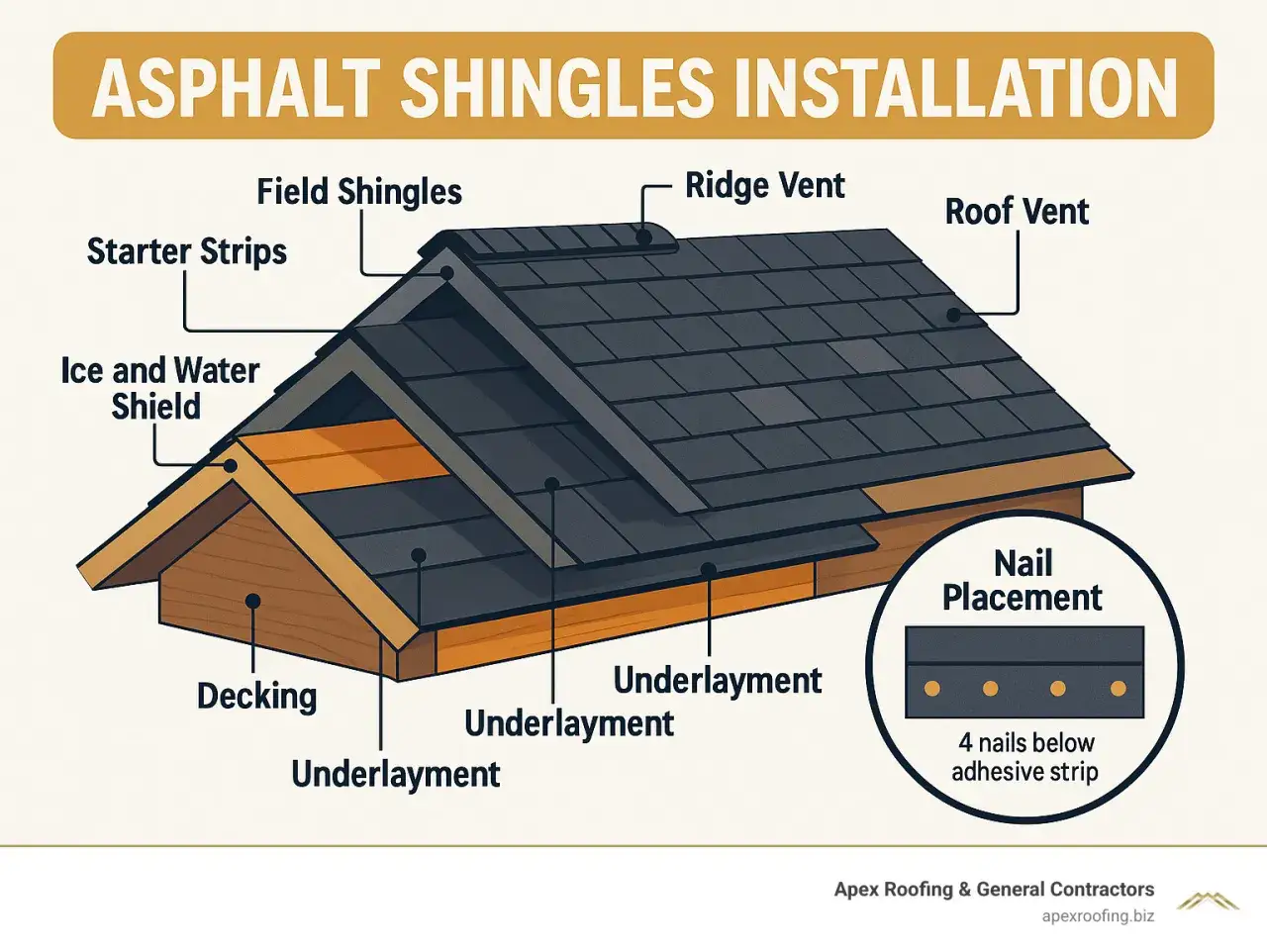
According to the U.S. Department of Energy, asphalt shingles are built from a fiberglass web coated with filled asphalt or modified asphalt and surfaced with ceramic-coated rock. That layered structure is what lets the roof shed water while still giving the assembly a chance to breathe. Once you see the roof as a layered system instead of a single surface, the important details start to stand out fast.In a typical residential assembly, I think in terms of the deck, underlayment, starter strip, field shingles, ridge caps, flashing, and ventilation. The asphalt does the waterproofing work, the granules protect the surface from sunlight, and the underlayment backs up the shingles when wind-driven rain gets under the top layer. If one of those parts is missing or poorly detailed, the failure usually shows up at the seams, edges, valleys, or penetrations first.
That is also why gutters matter here. When water is managed cleanly at the eaves, the whole lower edge of the roof stays happier. When gutters overflow or drip edge is missing, the roof edge, fascia, and starter course take a lot more abuse than they should.
Once the structure is clear, the product choices make a lot more sense.
The product types that fall under asphalt roofing
In residential work, I separate asphalt products into a few practical buckets. They are not interchangeable, and they are not all meant for the same slope or job.
| Product | Best fit | Why it works | Main limitation |
|---|---|---|---|
| Laminated or architectural shingles | Most steep-slope homes | Good curb appeal, more depth, and better wind performance than basic strip shingles | Costs more than entry-level shingles |
| Strip or 3-tab shingles | Budget-conscious re-roofs | Simple profile, lighter weight, and familiar installation | Less visual depth and usually less premium performance |
| Mineral-surfaced roll roofing | Sheds water on sheds, porches, garages, and other secondary structures | Low-cost coverage for smaller or less demanding roofs | Not my first choice for a primary house roof |
| Modified bitumen | Low-slope residential additions, porch roofs, and some mixed-use roofs | Reinforced membrane with strong waterproofing potential | Needs careful detailing and is not a shingle substitute |
| Built-up roofing | Flat or very low-slope roof areas | Multi-layer redundancy and proven weather resistance | Heavier and more labor-intensive |
For a typical steep-slope house, laminated shingles are usually the most balanced choice. For a utility building, roll roofing can be enough. For a low-slope section, I want a true membrane system, not a roofing product forced into the wrong geometry. The next filter is the house itself: slope, weather, and how much maintenance the owner is actually willing to do.
How I choose the right system for a house
I narrow the choice by roof geometry, climate, and maintenance reality, not by warranty language alone. On a quote sheet, I want the pitch, the number of valleys and penetrations, the attic ventilation plan, and the condition of the deck if a recover is being proposed. I also want to know how much waste the roof will create, because a simple rectangle and a roof with dormers are not priced or built the same way.
- Roof slope determines whether shingles are the right answer at all.
- Climate changes what matters most, from UV exposure in the South to ice-dam control in cold states.
- Roof complexity raises both material waste and leak risk.
- Existing layers matter because a recover is not always allowed or sensible.
- Attic ventilation affects heat, moisture, and shingle life.
- Roofing squares matter in estimates because one square equals 100 square feet, and the real roof area is usually larger than the footprint.
In hot, sunny regions, I pay more attention to solar reflectance and attic heat buildup. In snowy regions, I care more about eave protection, ice-dam resistance, and how the roof handles freeze-thaw cycles. A darker roof can still be the right choice if the attic is vented properly and the owner prefers the look, but I would never let style outrank fit. Once the system is chosen, the installation rules become the real make-or-break factor.
Installation details that decide whether it lasts
NRCA recommends a single layer of No. 15 asphalt-saturated underlayment on roofs with slopes of 18 degrees or greater, and a minimum of two layers of No. 15 on roofs between 14 and 18 degrees. For heavier shingles with longer expected service life, No. 30 underlayment is often the better match. Two layers of No. 15 are not the same as one layer of No. 30, so I always want the exact spec written down instead of assuming the crew will “do the right thing.”
- Use corrosion-resistant roofing nails, not staples, unless the code and manufacturer both allow otherwise.
- Flash valleys, chimneys, walls, skylights, and vents carefully, because those are the leak points that matter most.
- Keep intake and exhaust ventilation open so attic air can move from soffit to ridge.
- Install drip edge cleanly and coordinate it with the gutter line so runoff does not wick back into the fascia.
- Repair rotten, warped, or brittle deck sections before the new roof goes on.
- Check whether a recover is allowed, because local ordinances and layer limits can change the answer fast.
That last point is where homeowners get surprised. Asphalt shingles can often be installed over an existing roof, but only when the old surface is sound enough and the local rules allow it. If the deck is weak or the previous roof is already stacked too high, tear-off usually becomes the safer and smarter move. When those details slip, the roof usually tells you in predictable ways.
What failure looks like before you have a leak
I start with the ground, not the roof. Binoculars, a slow walk-around, and a flashlight in the attic can tell you a lot without stepping on brittle shingles. Cracked, curled, or missing shingles; heavy granule loss; and wet spots or stains on the underside of the deck are the patterns I take most seriously.
Granule loss is not just cosmetic. The granules shield the asphalt from ultraviolet exposure, so once the coating is gone, the aging rate tends to accelerate. Hail can bruise shingles and dislodge granules without creating an obvious hole, which is why a roof can look acceptable from the street and still be in trouble after a storm.
Gutters belong in the same conversation. When they clog, water backs up at the eaves, the starter course gets hammered, and splashback can soak the fascia and edge details. I treat roof and gutter maintenance as one job, because separating them usually leaves the weak link untouched.
If the damage is localized and the deck is still sound, repair is usually the better move. If curling is widespread, leaks keep returning, or the roof already has multiple layers and soft decking, replacement is usually the more honest long-term answer. From there, climate and heat management become the last layer of the decision.
Heat, reflectance, and climate tradeoffs
Cool asphalt shingles use lighter or specially coated granules to reflect more sunlight, but the gain is modest compared with some other cool-roof materials. I would view them as a useful upgrade in a hot climate, not as a magic fix for a roof that is already failing. Field-coating existing shingles is a poor shortcut; it can create moisture issues and may void the warranty.
In warm regions, reflective shingles can help reduce attic heat and ease the load on cooling equipment a bit. In cold regions, I care more about ice-dam control, balanced ventilation, and careful eave detailing than I do about color alone. Roof color matters, but moisture management matters more.
Safety and durability ratings can also be useful. Many asphalt shingle assemblies can achieve Class A fire resistance, and impact-resistant shingles are tested under UL 2218, with Class 4 being the highest rating. That does not mean every premium shingle is worth the extra cost, but it does tell you something real about how the roof should behave in hail-prone or fire-sensitive areas.
Before anyone signs off on the job, I want a short checklist that ties the whole system together.
The checks I would make before signing off on the roof
- Does the system match the roof slope and the existing layer count?
- Is the underlayment type and weight written into the scope of work?
- Are valleys, penetrations, and edges flashed correctly?
- Is attic ventilation balanced from soffit to ridge?
- Are the gutters clean, aligned, and sized to move runoff without backing up?
- Does the homeowner get both a product warranty and a workmanship warranty?
If those boxes are checked, asphalt roofing is usually a dependable, repairable choice for U.S. homes. If they are not, the cheapest quote often becomes the most expensive roof in a few seasons, and that is the mistake I try to help homeowners avoid.